
Death Before Dishonor?

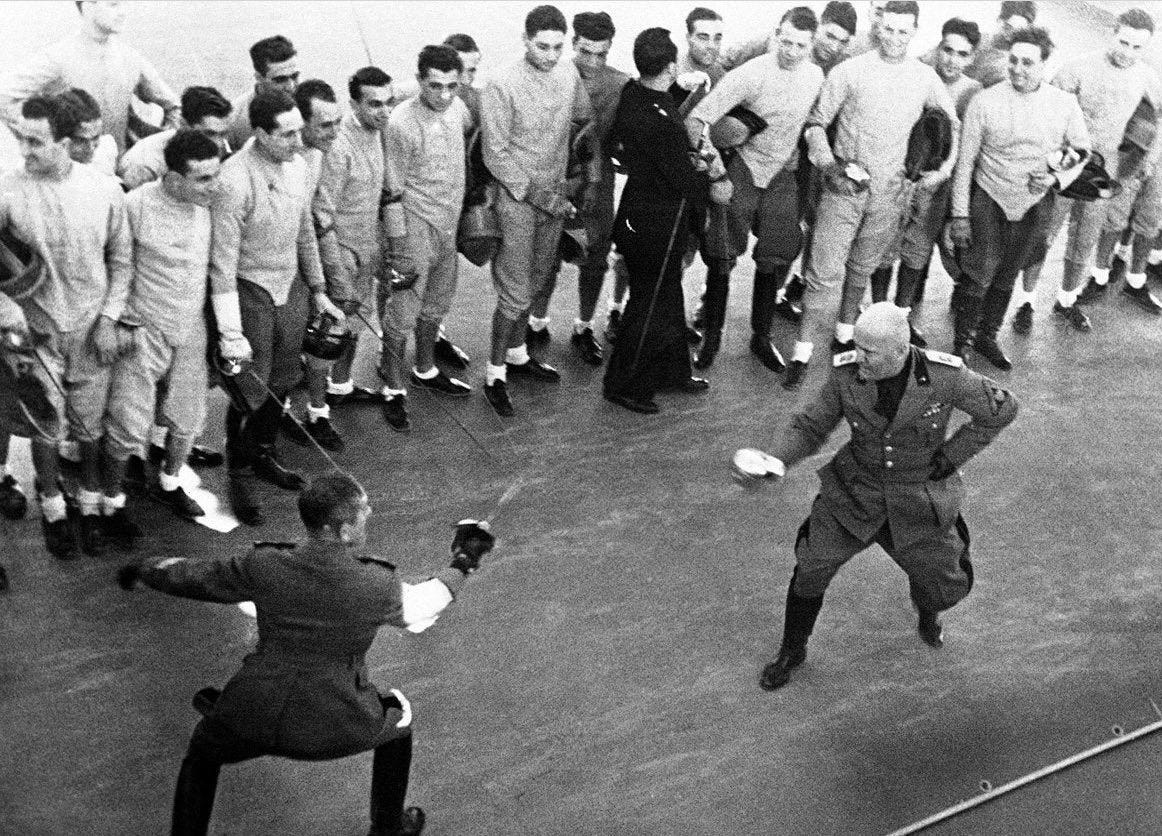
There exists a singular and uniquely human phenomenon that cannot be accounted for by the logic of survival or the arithmetic of gain.
It is the duel to the death over honor, a conflict in which the outcome is not measured in profit or advantage, but in recognition—in the affirmation of one’s worth before another and before the world. This, Hegel teaches in the Phenomenology of Spirit, is the true beginning of history: not the mere passage of time, but the unfolding of man’s self-consciousness, the drama of spirit awakening to itself through struggle, negation, and the will to be more than nature.
The animal fights to dominate, to reproduce, to preserve its life. But the animal yields when the odds turn. There is no shame in its retreat. It is bound by instinct, by the immediate necessity of survival, not ego. Man alone may choose otherwise. He may stand firm when reason counsels flight, when desire screams for safety. He may, in the presence of another, stake not merely his life but the meaning of his life upon the affirmation of something higher: honor, dignity, the adamantine conviction that some things are worse than death.
From this primal encounter—one man facing another in a struggle not of appetite but of spirit—history is born. The victor becomes the master, not merely by prevailing, but by demonstrating that he is governed by something higher than survival: the sovereign law of spirit over necessity. The vanquished, if he chooses life over honor, if he pleads for mercy and surrenders his claim to equality, becomes the slave. In this moment, a hierarchy is established: not one of brute force, but of inner disposition. The master affirms his transcendence of necessity. The slave retreats into it.
This foundational division, understood in Hegelian terms as the master–slave dialectic, gives rise to the fundamental structure of civilization. The first order, the master, seeks to live nobly, to impose form upon life. The second, the slave, seeks merely to persist within it. The master assumes the burden of leisure, of cultural creation, of the articulation of values. The slave labors under necessity, securing the material basis upon which the higher life depends. One becomes the guardian of spirit, the other the servant of matter. The one is Prometheus, shaping fire into form. The other is Epimetheus, forever late, forever reactive.
The course of history, then, is not simply the accumulation of events, but the ongoing attempt to reconcile these opposed principles within the soul and within society. For Jacob Burckhardt, history was not a science of causes, but a theatre in which the higher powers of the human soul revealed themselves in moments of creation and collapse. Civilization, in his view, emerged only where spirit asserted itself against necessity, where man shaped life rather than submitted to it. Hegel, more systematic and speculative, sought to uncover the logic behind this drama. He believed that the dialectic between mastery and submission would ultimately resolve itself in the universal recognition of freedom—that all men, through historical struggle, would come to see themselves as free beings, and that political life would be transformed by this insight. When such a society emerged, history as the agon (struggle) of becoming would reach its consummation. The task would be complete; the stage cleared.
Yet this vision rests upon a dangerous assumption, perhaps the most perilous of our age: that all men possess the inner structure of the master, that all are equal in capacity. From this illusion springs the toxic creed of radical egalitarianism. Its dominion over the modern world proceeds not from truth, but from the denial of the inegalitarian nature of life itself: of nature, of history, and of the individual soul of man.
Hegel himself, despite his idealism, was not blind to the corrosive tendencies of modernity. He observed the leveling force of commerce, which reduced man to consumer and producer, the slow erosion of virtue in an age ruled by the calculating mind of the merchant. He foresaw that where spirit gives way to base appetite, where the ethical life is displaced by self-interest, civilization sinks into bureaucracy and culture dissolves into utility. The internal tensions he identified, between freedom and necessity, spirit and matter, would be taken up by his successors, who sought not only to interpret the dialectic, but to bring it to its conclusion: Karl Marx, Alexandre Kojève, and, in our own time, Francis Fukuyama.
Marx envisioned the overcoming of alienation not through moral elevation or the refinement of character, but through economic revolution. By alienation, he meant the condition in which man becomes estranged from the work of his hands, from the products of his labor, from his fellow men, and ultimately from his own nature. Capitalism, in Marx’s view, severed the bond between man and his essence. For Marx, the remedy lay in the abolition of private property, the dissolution of class hierarchy, and the eventual formation of a society liberated from all structural divisions.
Kojève, interpreting Hegel through Marx, believed that history would end in a universal and homogeneous state, where all prior distinctions—master and slave, citizen and subject, will and law—would be reconciled in a rational totality. When the Soviet project collapsed beneath its contradictions, this vision was transposed onto liberal democracy by Fukuyama, who declared that global capitalism and procedural equality had achieved what revolution could not: the final form of human government, and the end of history. What Marx had demanded through struggle, Fukuyama now promised through consensus. The future would belong not to greatness or sacrifice, but to comfort and consumption, regulated by markets and administered by law.
But what kind of man inhabits such an end? Not the hero, not the statesman, not the founder of orders, but the client, the spectator, the consumer. Kojève himself foresaw that the universal state would not be composed of masters, but of slaves. In the words of C. S. Lewis, these are “men without chests,” who no longer feel shame, who no longer grasp that dignity requires limits, effort, and pain. And in Nietzsche’s formulation, this is the age of the Last Man, who blinks, who grins, who believes he has invented happiness, and who has forgotten how to despise himself.
Modern liberalism, whether classical or progressive, rests upon the sovereignty of desire. It treats the individual not as a bearer of duties, but as a bundle of preferences entitled to satisfaction. Reason, once the guide of the soul, is deprived of its normative authority and made a servant to convenience. Honor is dismissed as irrational, for it serves no utilitarian end. The virtues that once upheld civilization—restraint, courage, self-overcoming, and fidelity to the unborn—are displaced by legal entitlements, consumer appetites, and procedural fairness.
This is not history’s consummation, but its collapse into inertia. A civilization that sanctifies equality, abolishes distinction, and elevates comfort above greatness does not carry history to its culmination; it brings it to a standstill. And it does so under the strange and impoverished presumption, peculiar to the modern age, that time is linear rather than cyclical, that history progresses rather than returns.
For history, in its higher sense, is not the management of desire, but the drama of man’s struggle to live according to form. It is the continual contest between the one who governs himself and the one who seeks to be governed by others, between the master who affirms value through sacrifice and the slave who evades suffering through submission. When the will to distinction is abolished, when the burdens of nobility are cast aside, what remains is not peace, but stagnation: a world preserved in comfort, yet hollowed of the principles that once made life meaningful.
There remains, however, a final irony. Even at the terminus of this long descent, the possibility of a beginning endures. So long as there are men who will stand for honor against humiliation, who will choose death over dishonor, who would rather suffer than submit, then the flame of history has not been extinguished. It may flicker. It may withdraw into hidden altars and private sanctuaries, but it remains. It endures, for time is not a straight road, but a wheel, and in its turning the old patterns return.
Such men cannot be legislated into existence. They are not the result of conditioning, nor of consensus. They arise in solitude, in refusal, in the silent decision to uphold what cannot be taught but must be remembered. And when they appear, they remind the world that freedom is not the absence of constraint, but the expression of spirit bound to a higher law.
So long as the duel endures, so too does the tension between mastery and servitude, the primordial axis upon which the drama of man turns. Within this tension lies the enduring possibility of ascent. Not as a consumer adrift in the undifferentiated mass, but as a man among men, summoned not to the serene fiction of security, but to the austere path of sacrifice and the higher vocation of conquest. Though the age is dark and the hour grows late, the memory of form has not been extinguished. It lingers in silence, in exile, in the hidden sanctuaries of the soul that still remembers how to kneel before greatness and how to stand unflinching before death.
This essay was first published on my X account, @ccrowley100. It now appears here in expanded form for archival and wider accessibility.
Given that by all reasonable criteria we are living in the terminal phase of the current civilisational cycle and conditions hostile to any real and worthy human existence, there seem to be two and only two options for those seeking such: physical(and therefore mental and spiritual) withdrawal from the world or mental and spiritual withdrawal from the world while living in it. The latter is probably more difficult, but has faster results if done properly. I chose the later in my early 20’s , 50 years later, my only regret is that I am a slow learner.