
The National Revolution
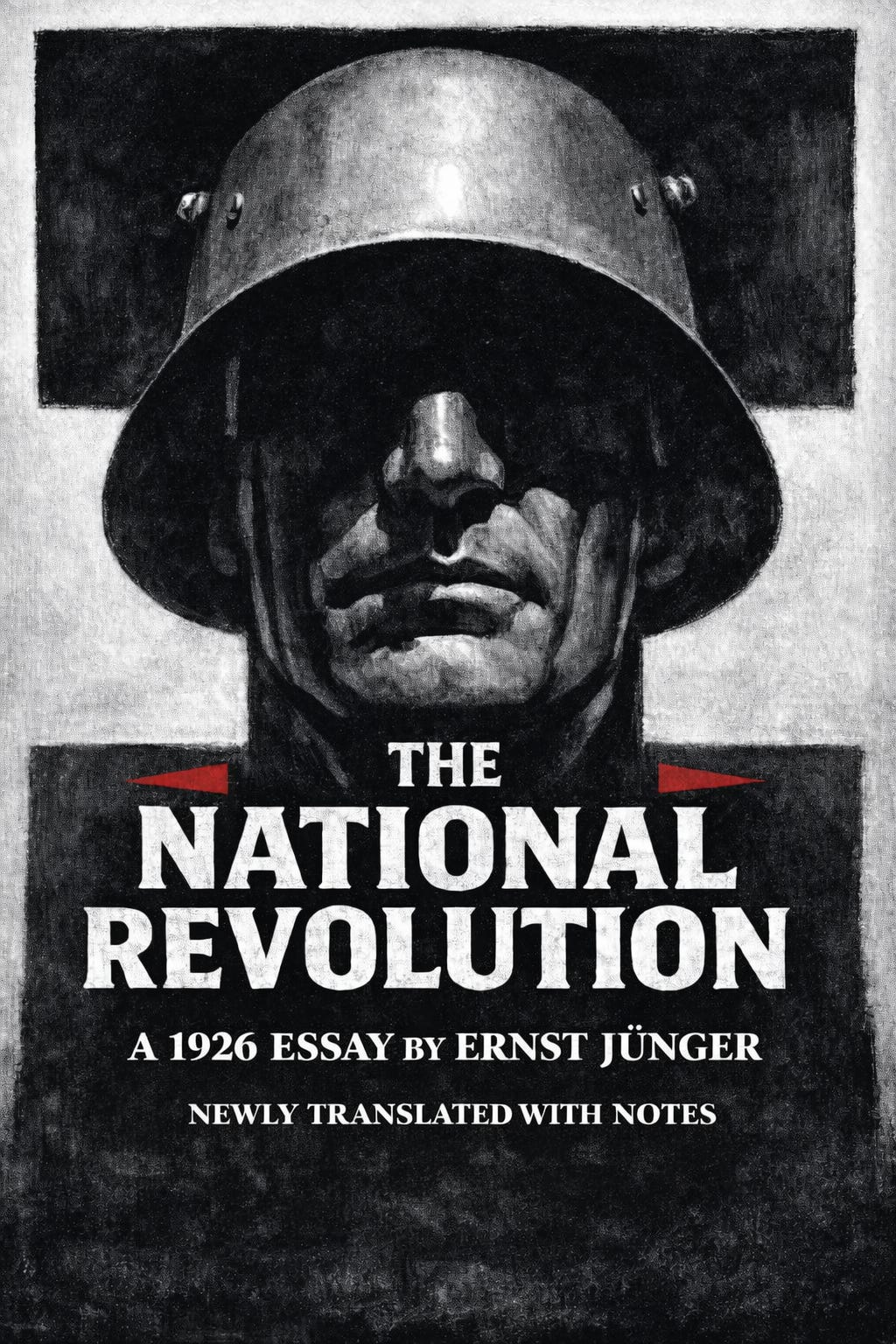
A 1926 essay by Ernst Jünger on revolution and the crisis of liberalism, newly translated with notes

Translator’s Introduction
Ernst Jünger’s essay Die nationale Revolution (“The National Revolution”) appeared in Die Standarte (“The Standard”)1 on 20 May 1926. It belongs to the same brief yet intense phase of writing in which Jünger sought to give political and spiritual articulation to a postwar generation hardened by civilizational collapse. Written in the same year as Wille and Das Blut, the essay proceeds in a more direct and openly political register.
The text arises from the chaos of the Weimar Republic, when military defeat and the revolutionary overthrow of imperial authority left Germany suspended in political uncertainty and deprived the old order of its foundation. For many veterans, the end of the war did not conclude the conflict but merely transferred it from the battlefield to the streets. Parliamentary reconstruction and liberal appeals to moderation proved unequal to the magnitude of the rupture that had opened in 1918. In such an atmosphere, the word “revolution” could no longer signify a simple change of government. It denoted the destruction of an established order and a contest over the future form of the German state and its rank within European civilization.
Jünger writes in this interwar hour out of a generational struggle to seize and redirect the course of Germany’s destiny. The essay bears the temper of his early style, formed in defeat and in the shock of political collapse, and stands in open refusal of liberal restoration and parliamentary compromise. Its language is severe and stripped of consolation. Revolution appears not as mere upheaval but as discipline and preparation for a Germany reborn. The text calls for the shaping of a new type of man and for the consolidation of a political force capable of action at the decisive moments of history.
In translating this essay, every effort has been made to preserve the firmness and cadence of the original German, without mitigation of its severity and without concession to contemporary idiom. Where Jünger writes in abrupt strokes, issuing clipped commands and compressed assertions, that abruptness is retained. His early prose does not yet possess the measured composure of the later works. It moves forward with militant clarity, forged in war and hardened in the convulsions of Weimar Germany.
Read in conjunction with the other essays of 1926, Die nationale Revolution discloses a moment in Jünger’s development when thought and action stood in immediate unity. The symbolic architectures of the later works had not yet taken form. The prose carries the urgency of its hour and the pressure of its crisis. It speaks for a generation that refused submission and placed itself in opposition to the disorder of its time.
End of Translator’s Introduction
In calling ourselves by the honorable name of nationalists, we turn our backs not only upon those who speak the name as a curse, but upon the entire peaceful bourgeois world. The essence of our movement lies in the defense of life’s values through military means. Whether such means accord with any universal morality does not concern us. Our movement stands upon front-line soldiers, living men who cleave to duty with love and joy.
These are not merchants or proprietors of marzipan factories who diluted the army’s fighting spirit with their bourgeois timidity in the age of universal conscription, but men who carry danger within themselves, for danger is their native element.
They are not pampered children whose concern for the state lasts only so long as generals’ uniforms and black-white-red banners2 fill the streets, and who, once the thrones had fallen, lost all sense of meaning in world history. Had these custodians of the existing order and its inertia, for whom liberalism might arrange pensions in exchange for eternal loyalty, stood decisively for nationalism, the November Republic3 would have been secured. There would have been no need for emergency legislation; after the empty contest between conservative and democratic liberalism, the appetites of the movement would have been appeased, together with those of its blood-relatives, the communists.
But such simplicity was never to be expected.
Today the possibility of a national revolution stands before us with unmistakable clarity, and within it lies the mortal end of liberalism. A single gust would be enough to sweep away its laws and expose the loudly proclaimed and supposedly unquestionable achievements of 1918 as fragile constructions4.
Nationalism itself scarcely believes in this possibility, for it is inconceivable without war and a subsequent reordering of the forces of life. Its backbone consists of nationalists so accustomed to the vast apparatus of the state that, when it vanished, the ground fell from beneath their feet. Nationalism could not cast off these forms like a worn garment; it required time to overcome within itself the structures of a state that had long ceased to correspond to reality.
The spontaneous uprising in Munich5 marked the first step toward liberation.
Yet along this path new forces were set in motion. The will broke its chains and cast aside its restraints; it awakened to a freedom greater than any the German people had ever possessed.
Thus the essence of nationalism stands revealed. The old forms sink into history; their preservation is the work of philistines and of journals such as Die Weltbühne (“The World Stage”)6. The nationalist’s first obligation is to turn from such weaklings, these so-called opponents, and deny them even the dignity of contempt.
Their task is to arm themselves at any cost for the struggle against the existing order, scarcely different from that of 1919, which is but a newly plastered façade set before a rotting structure. Cast it down; leave not one stone upon another7.
To prepare nationalism for this task: that alone gives the Revolution of 1918 its meaning. Through it the German shed his fear of revolution, and the impediments before the nationalist will were swept aside. This path must now be made truly revolutionary, so that liberalism may be dealt its mortal blow and the nationalist will hardened in the ordeal.
A nationalist may not concede even the possibility of another outcome. His task is to bring forth Germany’s first true revolution, a revolution founded upon wholly new ideas.
Revolution. Revolution.
This must be proclaimed without interruption and without concession, even if it demands a decade of persistence. Few have yet comprehended the full severity of this demand. Sentimental rhetoric of universal brotherhood and unity still flaunts itself in bright colors.
Let such talk go to hell, or to parliament, where it belongs. In the world we seek there is no unity of opposites; there is only struggle.
The national revolution requires no guardians of peace and order. It calls for men who declare that you shall fall by the edge of the sword8.
For a century the name of revolution has been rendered harmless in Germany. It must again become terrible.
The Great War gave rise to a new and dangerous type of man. He must be summoned to action.
So let us begin, comrades. Let us take our place within the fighting ranks; to revolutionize them is our first task. Let comforts fall away and numbers diminish, so that men of action may multiply. Let command be unified and the will hardened. Win the workers. Cast out those who preach the gospel of the eternal market and perpetual security. We are not the jailers of the workers.
We shall forge the trade unions into nationalist cadres of struggle, led by workers of nationalist conviction. On the nation’s barricades9 they will accomplish more than Marxism has in fifty years.
And what of the universities, the youth movement10, and all those organizations that concern us? Where else is new growth to arise? What holds the state together? Cooperation and opposition. And how is it to be overthrown? Only through withdrawal and attrition, through the creation of a state within the state, self-sufficient in principle and in its means of struggle.
How is the German nation to be won? It is the nationalist spirit, and it alone, that has both the will and the power to seize it.
To be a nationalist in war meant readiness to die for Germany. Today it means to take up the banner of revolution for a Germany greater and more beautiful. This is the charge laid upon the finest and most ardent youth of the nation.
Die Standarte (“The Standard”) was a short-lived nationalist periodical published in 1926 during the early consolidation of the Weimar Republic. Edited by Franz Schauwecker, it served as a forum for younger veterans and writers associated with the Conservative-Revolutionary milieu who sought to redefine Germany’s political direction after the collapse of the Empire. Though its existence was brief, the journal occupies a notable place in Jünger’s early development, as several essays written for his projected book cycle Grundlagen des Nationalismus (“Foundations of Nationalism”), which never came to fruition in its intended form, first appeared in its pages.
The black-white-red banners were the imperial colors of the German Empire (1871–1918). During the Weimar Republic they served as a visible emblem of monarchist and nationalist opposition to the republican black-red-gold flag adopted in 1919. In the political culture of the 1920s, these colors signified attachment to prewar imperial identity and an assertion of continuity with the Reich.
The “November Republic” refers to the Weimar Republic, proclaimed in the aftermath of Germany’s military collapse in 1918 and the abdication of Kaiser Wilhelm II. The epithet was employed by nationalist critics to underscore its revolutionary and defeat-born origins, portraying the new liberal, post-Wilhelmine Germany as an artificial construct and thereby denying it historical legitimacy.
The “achievements of 1918” allude to the political settlement that followed the November Revolution: the abolition of the monarchy, the establishment of parliamentary democracy, the extension of suffrage, and the recasting of the German state along liberal-democratic lines. For nationalist writers of Jünger’s generation, these measures epitomized the political consummation of military defeat and the dissolution of the old order.
The “spontaneous uprising in Munich” refers to the failed Beer Hall Putsch (Hitlerputsch) of November 1923, led by Adolf Hitler and members of the National Socialist movement in an attempted seizure of power against the Bavarian government and the Reich authorities. Although it collapsed within two days, the event was regarded in nationalist circles as a formative act of defiance against the Weimar state and a precursor to a wider national upheaval.
Die Weltbühne (“The World Stage”) was a Berlin weekly that evolved from a theatrical review founded in 1905 into one of the most influential radical-democratic journals of the Weimar Republic. Under editors such as Siegfried Jacobsohn and later Carl von Ossietzky, it became known for its liberal and pacifist stance and its consistent opposition to militarism. By the mid-1920s it stood in open hostility to nationalist and conservative-revolutionary movements.
The phrasing recalls Matthew 24:2, “there shall not be left here one stone upon another,” spoken in reference to the destruction of the Temple in Jerusalem. In its Gospel context the words signify the collapse of a sacred order. In Jünger’s usage, the cadence intensifies the call for the total destruction of the existing political structure and conveys a tone of irrevocable judgment.
The phrase echoes Luke 21:24, “and they shall fall by the edge of the sword.” In its biblical context the line foretells catastrophe and subjugation. In Jünger’s adaptation, the Scriptural diction heightens the severity of the revolutionary demand and frames political struggle in language traditionally associated with divine judgment.
Jünger uses the phrase auf den nationalen Barrikaden (“on the national barricades”). The term Barrikaden evokes the tradition of revolutionary street fighting in Europe, particularly the uprisings of 1830 and 1848 and the conflicts that followed Germany’s defeat in 1918. In the political vocabulary of the Weimar period, it signified open confrontation in the streets rather than parliamentary contest.
The term refers to the Jugendbewegung (“Youth Movement”), the broader current of German youth associations that emerged before the First World War, beginning with the Wandervogel (“Migratory Birds”) and later the bündische groups (from Bund, “league” or “covenant”). These associations cultivated communal discipline and a hierarchical ethos among German youth in deliberate opposition to the liberal individualism of the emerging modern age.
The nationalist’s first obligation is to turn from such weaklings, these so-called opponents, and deny them even the dignity of contempt.
Beautiful prose, and st apposite for the time we find ourselves in. Thank you for the translation Chad
Welcome on www.Nordlandia.nl and discover the Hanseatic Conservative Revolution, from Bruges to Novgorod. Its name is THE NORDLANDIA PROJECT. eBook & PaperBook are both in dual Edition English/Deutsch. Best Regards. Andre-Hans von BREMEN